

Platner
Skipping the diligence, building the narrative, defending the narrative against the evidence, panicking on deadline—and so, the Dems lose again

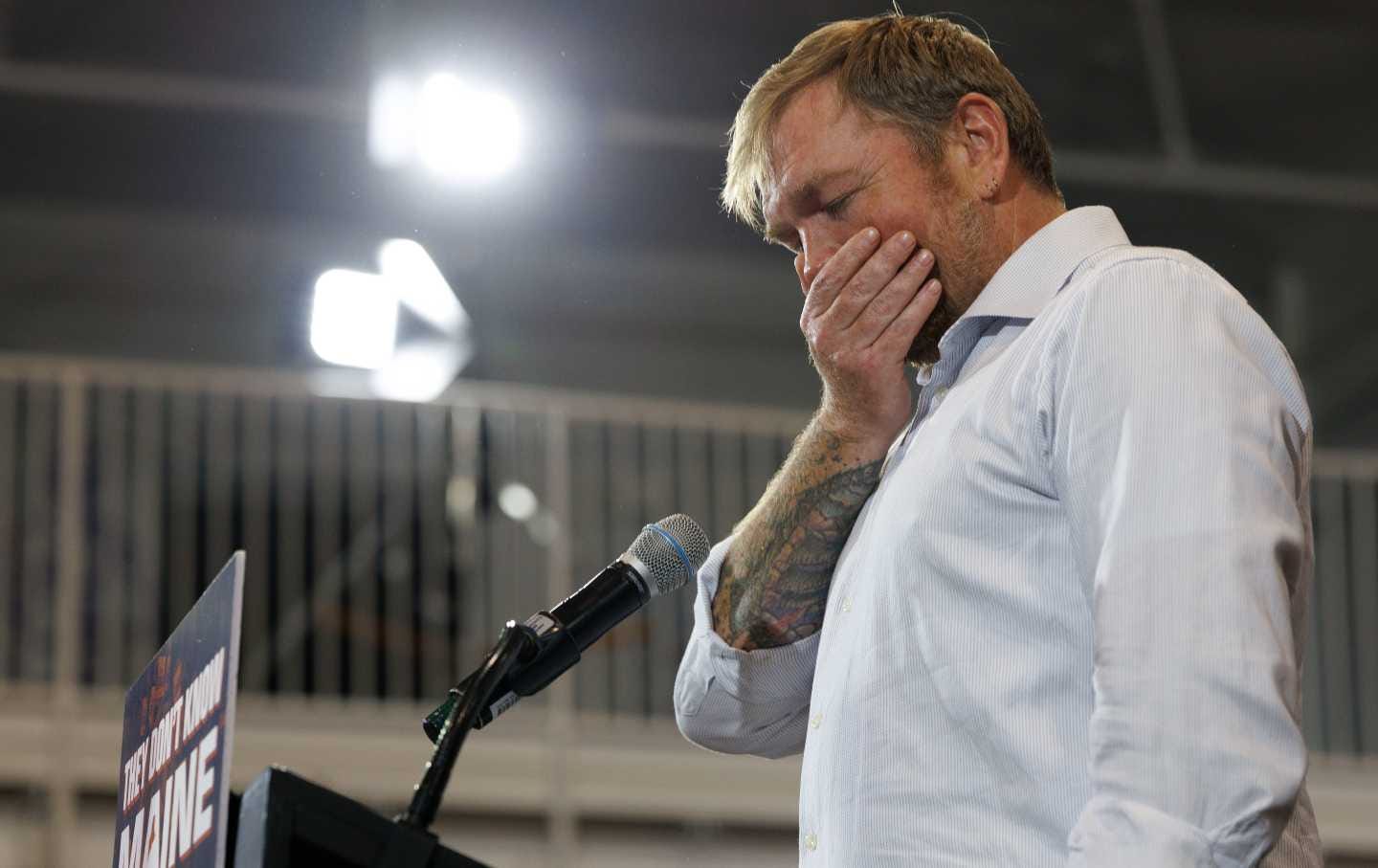
The political problem with Graham Platner, in addition to Monday’s news that a woman is now alleging that the Senate candidate drunkenly entered her home in 2021 and forced her to have nonconsensual sex, is that his primary nomination to run as Maine’s Democratic candidate for Senate in 2026 was built on party support that should never have been extended.
To note: Platner denies the woman’s account, calling any accusation of nonconsensual behavior categorically untrue, Politico reports. The accuser, Jenny Racicot, who dated Platner, has repeated the allegation on the record to the Washington Post and on camera to CNN. Whatever a court or the candidate’s conscience ultimately makes of her words, the political verdict has been reached, and it’s virtually unanimous.
It is a verdict America should never have had to deliver. And yet, America must, because no part of the Democratic Party, insurgent wing or establishment, did the diligence with Platner’s candidacy. The party’s left flank—Warren, Khanna, Gallego, the podcast wing—vouched for the man’s character amid every prior revelation, then withdrew its endorsements in a single news cycle. And the establishment’s contribution is, once again, propping up a candidate who is now being marched toward an early exit. It’s July 2024 all over again. No lessons have been learned.
Here’s how the disaster unfolded. The Wall Street Journal reports that Dan Moraff, the progressive strategist who recruited Platner and ran his launch, asked a Democratic research firm for an expedited, cut-rate review of the candidate rather than the thorough background check that has become standard in major Senate races. That would have been a weeks-long process costing roughly $20,000. Instead, New York-based Northside Research delivered a brief risk-assessment memo in three days for $6,250, federal disclosures show, in place of the usual research book that should have run hundreds of pages.
Northside’s memo flagged some of Platner’s problematic Reddit posts, but it missed the full trove. It also missed the death’s-head tattoo—the one resembling the Nazi SS Totenkopf—that Platner wore for 18 years before learning, he says, what it evoked. It similarly missed the sexually explicit texts he sent to several women after his 2023 marriage—texts his own wife discovered and reported to his aides, who decided they were a private matter.
Moraff’s postmortem, delivered to the Journal in late May, deserves preservation in amber: “We paid a nice firm a whole chunk of money and got some stuff back.” Platner’s former political director, Genevieve McDonald, resigned when the Reddit posts surfaced, telling the Journal she had trusted the campaign to have run its opposition research and cleared its own candidate. Poor choice, that trust. A campaign official told the paper there hadn’t been resources for a fuller vet—and that a fuller vet wouldn’t have found anything meaningful anyway. Idiotic stance. The reader may pause here to consider how much they would want to work with a team that delivered those kinds of results from those kinds of positions.
All Your Days can help. Here’s what it all means: There is something tactically, fatally fucked-up about the Democratic Party. This infuckulation has played—and is playing—a significant role in the whole run of atrocious Democratic defeats since 2016. And Democratic voters are deluding themselves if they think these same old players are going to deliver different results the next time. It’s time to call bullshit on the whole situation, America.
Start with the man who has driven the party’s Senate operation into disasterville over and over again. In July 2016, Charles Schumer surveyed the presidential campaign and announced that for every blue-collar Democrat Hillary Clinton’s campaign lost in western Pennsylvania, the party would gain “two moderate Republicans in the suburbs in Philadelphia,” a trade he said could be repeated in Ohio, Illinois, and Wisconsin, and a boast the Washington Post later held up as the emblem of the establishment’s blindness. And the Post was right: Clinton—deplorables gaffe and all—lost Pennsylvania, Ohio, and Wisconsin, and Schumer’s marquee recruits went down with her.
No strangers to doubling down on dogshit sandwiches, however, the 2020 Democrats ran the same play at even greater expense. In North Carolina, Schumer and the party’s Senate campaign arm reached into the primary and anointed Cal Cunningham, a clean-cut veteran who, the Associated Press noted, was a star recruit of the minority leader himself. Cunningham was straight out of central casting for the Schumer biopic, perhaps, but in October 2020, his sexts to a woman who was not his wife became public. Sound familiar? Nonetheless, the Democratic Senatorial Campaign Committee shoveled millions more into the race. Cunningham lost a must-win state by two points after leading in the polls, as Sabato’s Crystal Ball recounts.
The list ain’t finished yet. In Maine—yes, Maine (because for the Dems, history doesn’t just rhyme, it photocopies)—the party anointed Sara Gideon, who outspent Susan Collins 2-to-1 in a race that burned through more than $185 million statewide, and then, nevertheless, watched Collins, who trailed in virtually every public poll, win by nine points, as the Portland Press Herald reported.
What was wrong with Gideon? Nothing a background check would have caught, and that’s the other half of the lesson. Gideon was the machine’s dream candidate—sitting speaker of the Maine House, endorsed by the same Senate campaign arm—and she ran the machine’s dream campaign: cautious, message-light, and built as a referendum on Collins rather than a case for herself, leaving even sympathetic Maine organizers unable to say what she stood for, as Dissent magazine reported after the loss. Sound familiar. Does that rhyme with Kamala Harris’s campaign or photocopy it? Does it matter which? Also, Gideon’s war chest was a national one, built on out-of-state money at levels the Press Herald called unprecedented for Maine, and Collins spent the closing days running as the local candidate against it, as The 19th—a nonprofit, nonpartisan American newsroom that covers the intersection of gender, politics, and policy—reported. That’s a back foot in a tight contest.
To the tally, Americans can also add in the bonfires of cash the party lit elsewhere that year: Amy McGrath raised $96 million and lost to Mitch McConnell by 20 points; Jaime Harrison raised $109 million and lost to Lindsey Graham by 10, all according to the Intercept. A billion dollars. Not a win among them.
In fairness to Schumer, his governance calls have sometimes been better than his critics allow—i.e., keeping the government open in March 2025 was the right and defensible move, whatever the popular punditry and suburbanite discourse said otherwise. But the electoral machine is still Schumer’s machine, and its record since 2016 is a smoking crater with a fundraising list attached. And that’s on Chuck.
Chuck’s machine was humming away in Maine at both ends of the party’s current fiasco. First, Schumer backed Governor Janet Mills in the primary. She quit in April, citing money. Later, when Senate Democrats met privately with Platner amid the mounting revelations, Schumer emerged to pronounce that the party would beat Collins and take back the Senate, as Newsweek reports. That was June.
As of today, July 7, 2026, the same institutional voices—the Senate campaign arm, the aligned super PAC, the leadership—are stampeding for the doors, as the Times and the Washington Post report. Skip the diligence, build the narrative, defend the narrative against the evidence, panic on deadline. The sequence is not just a Platner problem. It is the hallucinatory operating system of a party that is no longer serving its constituents—or telling them the truth about its candidates.
Meanwhile, Republicans hold the Senate 53–47, which means Democrats must defend every seat of their own and flip four more, and the flippable four run through six Republican-held states, of which Maine—a state Harris carried by seven points, per the Times—was the ripest, the one Democrats widely considered their best flip, as the Journal reported. Even before the development on Monday, the signs were shifting: a Times/Portland Press Herald/Siena poll found Platner neck and neck with Collins, running behind the share of Maine voters who say they want Democrats controlling the Senate, but his side was on track to be outspent 2-to-1 on advertising through Election Day, according to the media tracking firm AdImpact, as the Times reports. Rich Democratic donors had already gone quiet, worried about what might surface next. Platner assured them privately there was nothing more to come. That was before Monday, too.
Now, what remains is the panic. Under Maine law, Platner must withdraw by July 13 for Democrats to replace him on the ballot at all, and the state party would then have until 5 p.m. on July 27 to name a successor, as the Washington Post reports. There is no process for doing this—none. The secretary of state’s office says it knows of no precedent for a Maine primary winner withdrawing before the general, and party officials are improvising between a pop-up convention and a statewide do-over caucus while the possible replacements—Shenna Bellows, Troy Jackson, Nirav Shah, Jordan Wood—jockey, all of this per the Times.
Platner, meanwhile, told his campaign staff on a private Monday-evening call that he believes he still holds leverage over who succeeds him, the Times reports, citing three people familiar with the conversation. And so, apparently, the nominee whose unvetted history detonated the race is negotiating terms for the wreckage. This is not how a party escorts its liabilities out of the building. Meanwhile, Collins—who, as the Times puts it, has dashed Democrats’ dreams for three decades—has to do approximately nothing. The Senate race in Maine is now the Republicans’ to lose.
Beyond that outcome, beyond that consequence, what the Platner fiasco has done, yet again, is supply a substandard but persistent argument that outsiders and outliers equal nothing but “bad” when it comes to forging new paths with new candidates from the center and left.
Vetting should not be viewed as a weapon against outsiders; vetting is what makes outsiders possible. A party that does its diligence can nominate the oysterman, the bartender, the machine-gunner, and stand behind them when the attacks come, because it knows the candidate’s file is clean. A party that skips that level of looksee is collecting time bombs. And the only things that grow in the craters those bombs leave will be consultant-approved mediocrities who raise tens of millions of dollars and still lose to incumbents by nine points.
The bottom line is: Liberals and the left can’t learn to work with candidates they might not invite to dinner if it turns out those candidates are cornering their guests in the dark and making off with the silver. America must let Platner go, yes, and in so doing, friends of democracy must also address a basic reality, which is that the Democratic Party can no longer be trusted. The party has demonstrated time and again that it will take the cheapest (and then the most expensive), fastest, least considered, least contextualized, and most bubble-bound approach to its problems at the worst possible time.
The Democrats have all but lost the Senate, and they didn’t have to. They chose to sacrifice their chances by choosing negligence. Again. And again. American voters—liberals and leftists alike—should recognize that they’re keeping the Democratic Party alive, and keeping it alive in its present state is the wrong call.
I can't remember the last time I voted *for* a candidate, rather than *against* his opponent. Neither of our two main parties offers reasonable, qualified, decent candidates with proven records of governing or management or policy-crafting ability. A life-long liberal, I now despise both parties. The Democrats are somewhat less bad than the GOP, but they're so ineffectual in countering the GOP's oligarchic, authoritarian slant - and display a similar slant themselves - that I quote Shakespeare: "A plague o' both your houses!"