USPS
The Postal Service is broke, Trump wants to use it to control who votes, and the regime is positioned to profit from both outcomes

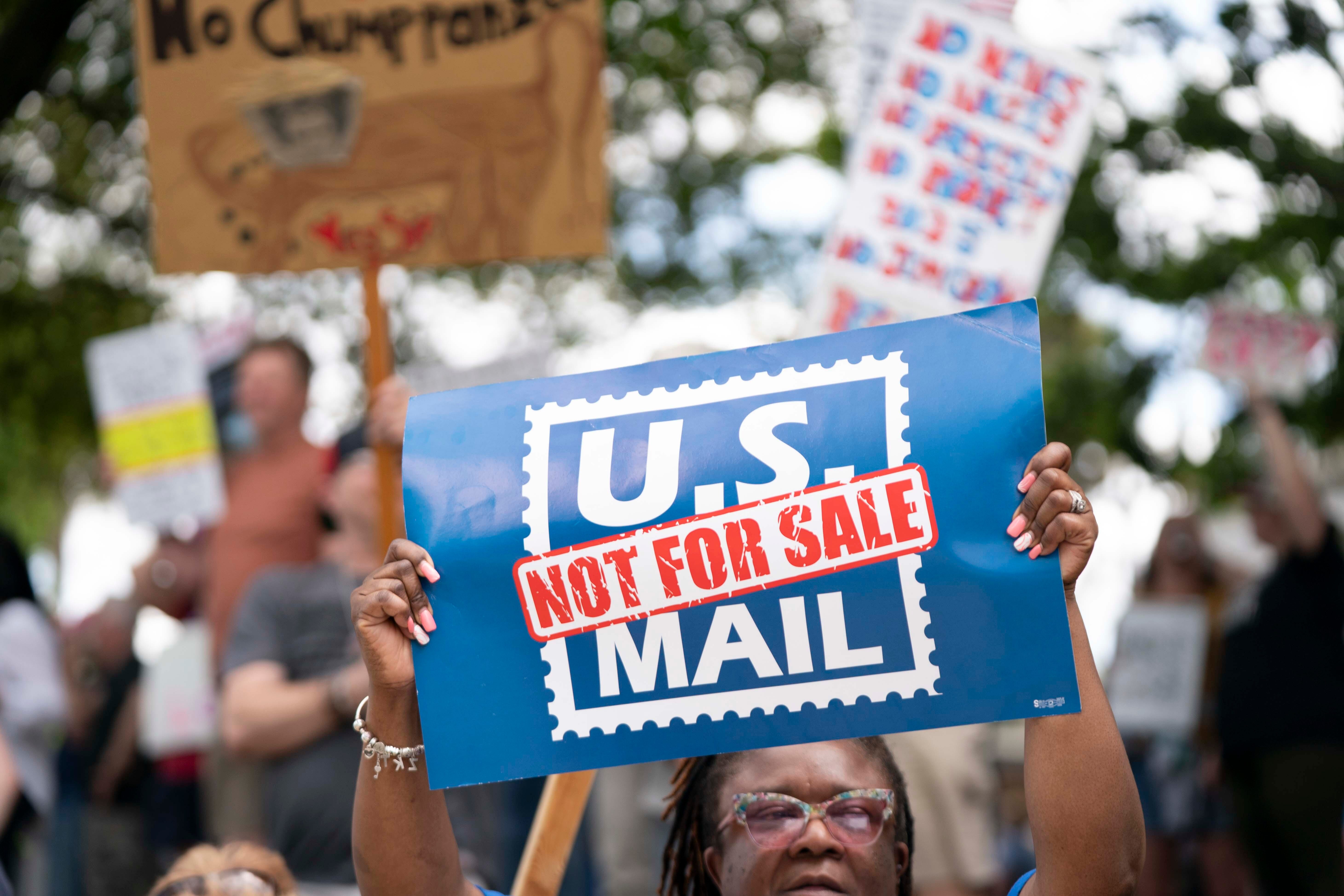
Nearly a third of all American voters cast mail-in ballots in the 2024 general election, according to the States United Democracy Center. That process is now under assault. On March 31, 2026, Donald J. Trump signed an executive order directing the United States Postal Service to function as a national ballot gatekeeper.
The president’s order—titled “Ensuring Citizenship Verification and Integrity in Federal Elections”—instructs the Department of Homeland Security and the Social Security Administration to compile a state-by-state list of eligible voters, then requires USPS to deliver mail-in and absentee ballots only to people whose names appear on that list. If the order goes through, states must submit their voter rolls to the Postal Service at least 60 days before any federal election. Furthermore, within the bizarre new system Trump describes, the attorney general would be authorized to withhold federal funds from non-compliant states. And election officials who send ballots to ineligible voters—even unknowingly—could be prosecuted.
And yet, this tumorous development is only the beginning of the story of what’s happening at the USPS. Trump’s new order goes further still. It is part of a plan that began as early as 2025, one intended to conscript the nation’s postal infrastructure—already under financial duress, already politically exposed—into a ballot-control role that serves the political whims of the regime while lining the pockets of the president’s friends.
The financial duress factor is critical to understanding the bigger picture of what’s underway. Two weeks before Trump’s new executive order was signed, recently appointed Postmaster General David Steiner appeared before the House Oversight Subcommittee on Government Operations and told lawmakers the agency would be “out of cash in less than 12 months,” the New York Times reported. Without congressional action, Steiner said, the Postal Service could not continue delivering mail to the roughly 167 million addresses it is required by law to serve.
By way of framework, the agency lost $9.5 billion in fiscal year 2024 and $9 billion in fiscal year 2025—about $25 billion over three years, according to USPS’s reporting. At its current pace, NPR reports, if it meets all required obligations (i.e., pays all its bills), the agency could exhaust its funds by fall 2026. If it defers some pension payments to buy time, the deadline extends to roughly February 2027. There’s little else it can do. According to the Times, USPS has maxed out its $15 billion federal borrowing limit—a ceiling set in 1992 and never raised.
How did the nation get here?
The USPS’s financial distress predates Trump. Mail volume has declined roughly 50 percent over the past two decades, falling from approximately 220 billion pieces annually to around 110 billion pieces annually, according to Steiner’s congressional testimony. The causes of that shift are not ambiguous. The word is “email.” First-class mail—historically the agency’s highest-margin product—has been hollowed out by digital communication. Package delivery was supposed to offset the loss. And yet, USPS delivered about 6.8 billion packages in fiscal 2025, down from 7.3 billion the year before, a 5.7 percent drop in a single year, Federal News Network reported.
Former Postmaster General Louis DeJoy’s 10-year modernization plan, launched in 2021 to arrest losses that had already totaled $87 billion over 14 years, was projected to reach break-even by fiscal year 2023. It did not. DeJoy stepped down in late March 2025. The USPS Board of Governors replaced him with Steiner, a former board member of FedEx, a direct private-sector competitor of the Postal Service, and the former CEO of Waste Management Inc. The appointment alarmed Democratic lawmakers and union leaders, according to the New York Times.
The reason for that alarm? The board is supposed to be legally independent, its governors serving staggered seven-year terms, no more than five from the same party. As of April 2026, its sitting members are predominantly Biden nominees. But the Washington Post reported that the board submitted its shortlist of finalists to the White House for vetting, and that Trump personally pushed for Steiner—a detail the late Representative Gerry Connolly of Virginia, who was then the top Democrat on the House Oversight Committee, called “a blatant conflict of interest and an attempt by President Trump to install a handpicked loyalist.” The board’s nominal independence, in other words, provided legal cover for a choice that served the administration’s purposes.
And within the context of those purposes, appointing Steiner was but a follow-on to a plan already underway.
In February 2025, Trump had floated a “form of a merger” that would fold USPS into the Commerce Department, with Commerce Secretary Howard Lutnick assigned to lead it. Anne Joseph O'Connell, an administrative law professor at Stanford, told the New York Times that such a move would violate the Postal Reorganization Act of 1970, which established the agency as an independent entity. "They would need congressional permission," O'Connell said. Congress has not granted that permission. No formal move to absorb USPS into Commerce has been made. But the administration has not backed away from the ambition. Americans would do well to note that Lutnick stood at Trump's side this week when the president signed the ballot-control order.
The crisis before the country is real and structural. What is specific to this administration is the choice it has made in response to it: appoint a former competitor’s board member as postmaster, float an illegal merger with Commerce, and allow the agency’s borrowing cap to remain frozen. At the same time, the clock runs out on USPS’s ability to operate.
There is a difference between inheriting a problem and deciding to use it—to perpetuate and exacerbate it even—for one’s own advantage. America is watching its corrupt and power-mad president pursue the latter option.
The implications of his pursuit matter because the U.S. Postal Service’s democratic function has never been incidental to its existence. It is integral to the institution’s reason for being. The USPS operates under a legal “universal service obligation,” a mandate to deliver to every address in the country at a reasonable and uniform price. No private carrier assumes that mandate.
What that additionally means is the provision of crucial communications—and, more recently, and more specifically, voting services—to every set of coordinates on the national map. Those coordinates include what James S. O’Rourke, a management professor at Notre Dame who has studied the Postal Service, speaking to the New York Times, said would be areas private carriers “probably don’t want”—meaning the rural routes, the remote addresses, the communities where delivery is expensive, and margins are thin. That’s about one-third of the Postal Service’s constituency, by the way.
It is in this context that Trump’s March 31 executive order lands. The people positioned to benefit—financially and politically—from the Postal Service’s collapse are not hard to identify. FedEx and UPS would absorb the profitable urban and suburban routes. And Trump—and Trump’s masters—would have the physical component of mail-in voting in their grip. Of course, the president hasn’t got any evidence of fraud to justify these moves—a Brookings Institution analysis found that mail-ballot fraud accounts for roughly four cases per 10 million votes cast—so, he’s going for the corporate plan: defund, demoralize, destroy, and assume ownership of the organization. And that ownership, by the way, comes with state voting lists to identify and act on—in whatever ways this regime would like to act.
Regarding responses from the side of democracy, Campaign Legal Center’s Danielle Lang, who represented plaintiffs against Trump’s first election order—a failed March 2025 attempt that would have required proof of citizenship for federal voter registration, restricted mail-ballot deadlines, and threatened to withhold federal funds from non-compliant states (it was blocked in federal court)—was unambiguous: “The president has no power to direct the creation of any of these lists,” she told Votebeat and Salon, “or to restrict the delivery of mail ballots to any given list.”
Also according to Votebeat and Salon, Wisconsin Elections Commission chair Ann Jacobs pointed to the order’s most dangerous gap: What if a state tries to add a late-registering voter to its list and the federal government says no? “What happens to those voters?”
The objections go on. Speaking to NPR, Rick Hasen, an election law professor at UCLA, called Trump’s new order likely unconstitutional and said its timeline made implementation before November’s midterms “virtually impossible” regardless. The Brennan Center for Justice, which had already successfully challenged Trump’s first election order, described the new one as “a car crash with a train wreck” to NPR, noting that the government’s citizenship databases are themselves incomplete and inaccurate. The National Rural Letter Carriers’ Association president, Don Maston, chimed in with NPR as well: “The Postal Service is not an election enforcement agency. It is not a substitute for state election administrators, and it is not equipped or authorized to decide who is or is not entitled to vote.”
And so, while these responses are somewhat reassuring, they are also mostly insufficient. Courts blocked the first order. They will likely block this one. But each round of litigation normalizes Trump’s attempts, spends the resources of voting-rights organizations, and gives the administration more time to install friendlier personnel at the agencies it is trying to conscript. The Brennan Center won in 2025, for example. It is in court again in 2026. Americans must remember that the goal of Trump’s legal and business strategy is never a single disruptive move. To Trump, it seldom matters if a given instance survives intact. It is the accumulated pressure of repeated attempts on institutions that are increasingly financially and politically weakened that represent his true game. Weaken opponents. Batter them. Take over the rubble.
Nonetheless, the states are fighting back. According to Votebeat and Salon, election officials in Arizona, Colorado, Nevada, Minnesota, Oregon, and Wisconsin have signaled plans to sue. The outlets also captured Arizona Secretary of State Adrian Fontes calling the order “a disgusting overreach.” Scott McDonell, clerk of Dane County in Wisconsin, predicted its legal fate: “The courts will strike it down faster than a cheetah on meth.”
Americans must hope that happens as quickly as McDonell suggests. Meanwhile, the administration’s operation to kill and mount the head of the United States Postal Service over Lutnick’s desk runs on two tracks, and it helps to revisit both at once.
The first track is financial strangulation. Allow the borrowing cap to remain frozen at its 1992 ceiling. Float an illegal merger that would strip the agency’s independence and park it inside the Commerce Department. Install a former FedEx board member as postmaster general. Watch the losses mount. On the other track: conscription. Issue an executive order directing the financially desperate, politically exposed agency to decide who gets a ballot. The financial crisis and the election order are not two separate stories. They are the setup and the execution. They are one plan.
America would do well to listen to Mark Dimondstein, president of the American Postal Workers Union, which represents more than 200,000 postal employees and retirees. He told the New York Times: “If this administration wants to help the finances, there are easy ways to do it besides having a coup.”
He meant it as a criticism. It also works as a description of America in 2026.