SAVE
MAGA’s mutated version of the SAVE Act would suppress voter turnout, unlock protected voter data, and upend the 2026 midterms

Whenever Donald J. Trump talks about U.S. elections, Americans of good conscience ought to worry. And the sitting president of the United States certainly talked about elections during Tuesday’s State of the Union address.
Specifically, Trump took a moment to call out the Senate and its majority leader, John Thune (R-South Dakota), regarding the mutated and corrupted version of the Safeguard American Voter Eligibility Act, which has—surprise, surprise—become yet another wolf in sheep’s clothing perpetrated by the regime upon the American people.
The SAVE bill’s framing idea is simple: “only citizens should vote.” Any normal person agrees with that concept. Indeed, the nation already widely goes along with that very idea—noncitizen voting in federal elections is illegal, and state systems require registrants to attest to citizenship under penalty of perjury. As such, the SAVE Act does not address a mass problem in the U.S. Its passage in the Senate would, however, pose a massive obstacle to certain American voters.
What the regime wants Americans to believe is that the SAVE Act safeguards “voter eligibility” by requiring documentary proof of citizenship at registration. The newest version, however, the one Trump is squeezing Thune to corral the Senate to pass, goes much further than that stated goal. The current version of the bill would require proof of citizenship to register to vote, and it would also create a nationwide requirement that voters show photo identification to cast a ballot at the polls. Furthermore, if passed, the SAVE Act would grant the Department of Homeland Security access to state voter rolls—putting a federal agency directly inside state election data.
Furthermore, the bill’s “acceptable proof” list leans on documents such as passports, birth certificates, military IDs, and Real IDs (even though most Real IDs do not prove citizenship). In these details lies the Trump-ian trick: the SAVE Act introduces a citizenship requirement enforced through documents and applications that require a level of bureaucratic savvy, procedural patience, and, ultimately, money for fees that many U.S. citizens do not possess.
For example, the Guardian cites estimates from the Southern Poverty Law Center: 21 million Americans lack a copy of their birth certificate or a passport. It also notes that those voters are more likely to be poor or people of color. The Brennan Center’s research focuses on the same factors: more than 21 million citizens of voting age lack ready access to proof-of-citizenship documents, and the SAVE Act’s specific requirements are expected to create document-access challenges even among engaged voters.
The bottom line? The SAVE Act is not narrowly tailored to fight election fraud. It is broadly tailored to suppress voting by introducing inconveniences that will amount to barriers—especially barriers for poor people, first-time voters, seniors, and women.
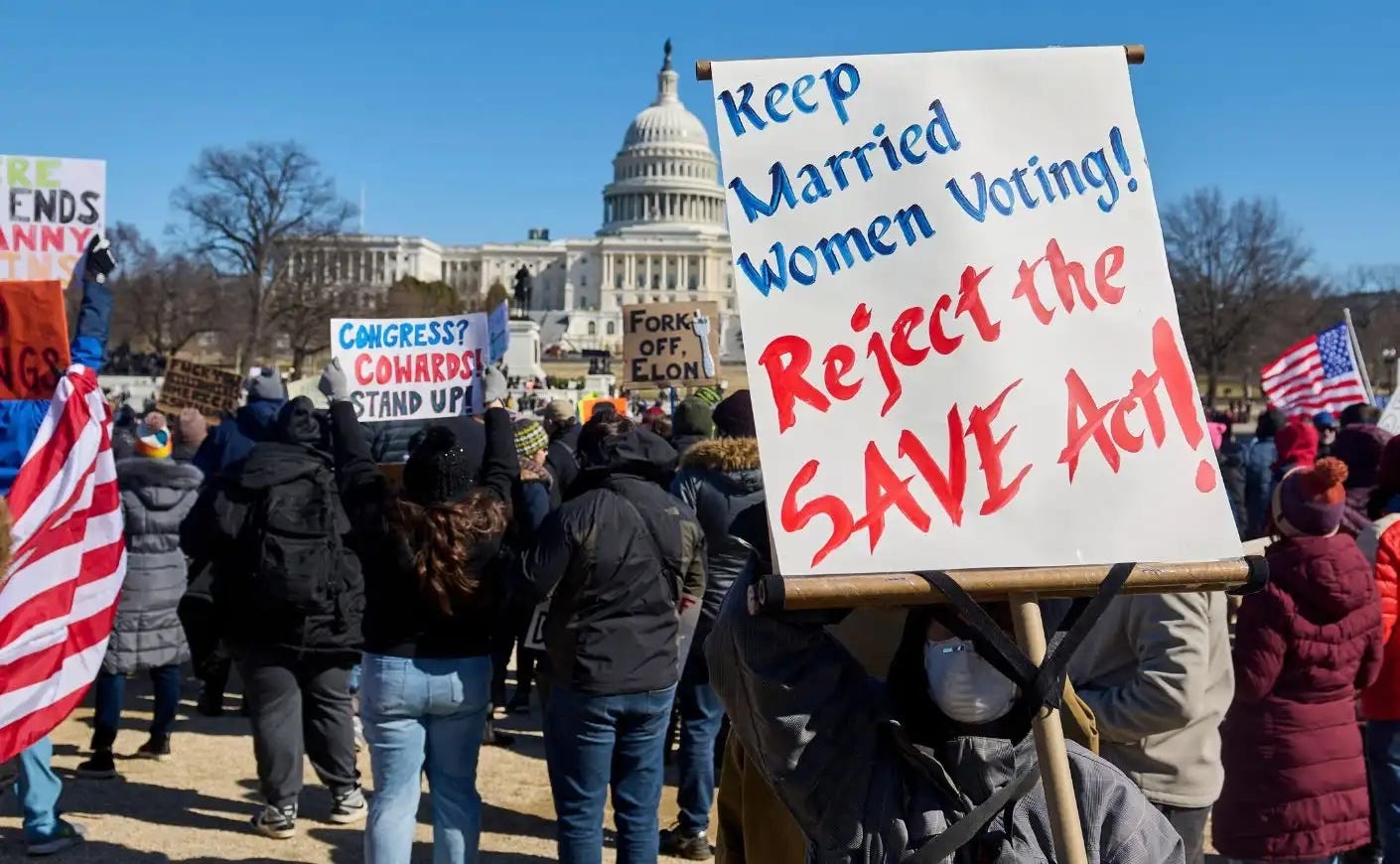
Married women whose documents don’t match their current names would face those barriers, for example. So would working-class people who don’t have a passport in their desk drawer. And it would restrict young people turning 18 who try to vote without a birth certificate in their pocket. Citizens who move between states and then register by mail? Plenty of barriers for them under the proposed SAVE Act. Seniors whose records are in a safe deposit box across town? They shall have to make do with fetching those documents, or perhaps they’d just prefer to stay home this November.
Even the SAVE Act’s implementation timeline is hostile to democracy. The Guardian notes that the rollout of the proof-of-citizenship requirements in the bill would take effect immediately, leaving states scrambling to align their voting systems to a new federal mandate in the run-up to the 2026 midterms. That sure is some convenient timing for a president freaking out about his poll numbers. Trump’s approval among independents stood at 26 percent going into the State of the Union, according to CNN’s polls. It’s hovering in the mid-30s overall.
Indeed, one reason for Trump’s urgency about the SAVE Act is the anticipated anti-Republican blowback this fall at the midterm polls. According to Rebekah Caruthers of the Fair Elections Center, quoted in the Guardian: “The whole point of this is to restrict who gets to vote in this country.”
Another reason is data and leverage over opponents in the months and years to come. Since the bill would give DHS access to state voter rolls—and since, starting in early 2025, the Justice Department has pursued sensitive state voter data through aggressive demands and lawsuits against dozens of states—successfully passing the SAVE Act would be yet another step in the regime’s overall pursuit of a national-security state.
One more reason for Trump’s urgency about SAVE at the SOTU podium is purely to create spectacle and amplify coercion inside the Senate itself. The New York Times reports that Trump and his allies have begun insisting on a “talking filibuster,” pressuring Thune to force Democrats to physically occupy the floor if they seek to block the bill. The point is on-screen confrontation: Trump wants to force Democrats to look like they’re “blocking election security,” and then use the footage as campaign fuel. This is the same Stephen-Miller-type strategy that led to the bullshit, authoritarian stand-up-and-show-your-loyalty tests that Americans witnessed at the president’s gaseous speech on Tuesday.
If there’s good news, it’s that the legal footing of the SAVE Act is shaky.
While proponents of the bill lean on the Constitution’s Elections Clause—Congress’s power to regulate the “Times, Places and Manner” of congressional elections, the cited section does not actually give Congress authority to set voter qualifications. The Supreme Court has explicitly stated as much. The Independent’s legal analysis cites the Court’s decision in Arizona v. Inter Tribal Council, which held, in 2013, that Congress can regulate election procedures but cannot invent a new voter-qualification regime that overrides state eligibility decisions.
That contested ground is actually part of the regime’s strategy, however. Should the act pass, and courts then block its implementation on Constitutional grounds, Trump can shit himself on Truth Social, claiming the “deep state” won’t let him fix elections. On the other hand, if it passes and courts don’t block the bill on Constitutional grounds, the regime gains new tools to shape and reshape the electorate. Either way, Trump wins the narrative. Welcome to America.
Should Congress bow to Trump and pass the SAVE Act in 2026, the immediate implication for American voters is straightforward: more people will show up to the polls with the wrong documents, or no documents, and will be told they cannot participate in a federal election. States will scramble to comply. Local election offices will become conflict zones. Frontline poll workers will be forced to carry out the regime’s paperwork crusade on their neighbors. And every inevitable mistake will be turned into propaganda. The implication for 2028 is darker: a presidential election run under a system that Trump has spent years priming as fraudulent (unless MAGA wins).
What’s likely to happen next in the Senate is a show-vote. As the Wall Street Journal assesses things, Thune will likely file a motion to proceed and force a floor confrontation. Democrats will probably filibuster. And Republicans don’t presently seem to have the 60 votes to invoke cloture and move to final passage. In other words, the SAVE Act can now come up any time Thune wants to pick the fight, but it probably won’t clear the Senate under current rules, and reporting says GOP leaders aren’t even in agreement on the procedural warfare, such as the talking filibuster that Trump is demanding.
These are good things for Americans. Because the question before Congress and the nation is not whether “only citizens should vote.” The question is why the bill is written to take effect immediately, as states head into the midterms—unless the goal is election disruption. The question is about telling the truth out loud about what the SAVE Act now represents in its corrupted form: an authoritarian attempt to use paperwork and bureaucratic hurdles to suppress the electorate and sow doubt about elections. And the question is about why the U.S. federal government wants to claw private American voter data into its coffers. To do with as they will.
The SAVE Act should be opposed in the Senate. It should be opposed in the courts if it somehow passes. The SAVE Act, as it stands, should be opposed in the states at every juncture. And it should be opposed by every American who refuses the ongoing Don-con. The SAVE Act is not about election integrity. It is election interference in a crappy blue suit and a shitty orange spray tan. The Senate’s job is to kill the bill. May it conduct itself accordingly.