

Outbreaks
Measles is back because denialism beat public health: falling vaccination, porous policy, and weak leadership are turning a solved problem deadly again

The United States is not alone in its race for a new Dark Ages, but it is absolutely leading the pack in the current lap of what amounts to an idiotic and deadly competition. The nation stands, in February 2026, as a vanguard in epidemiological denialism. And its consequences.
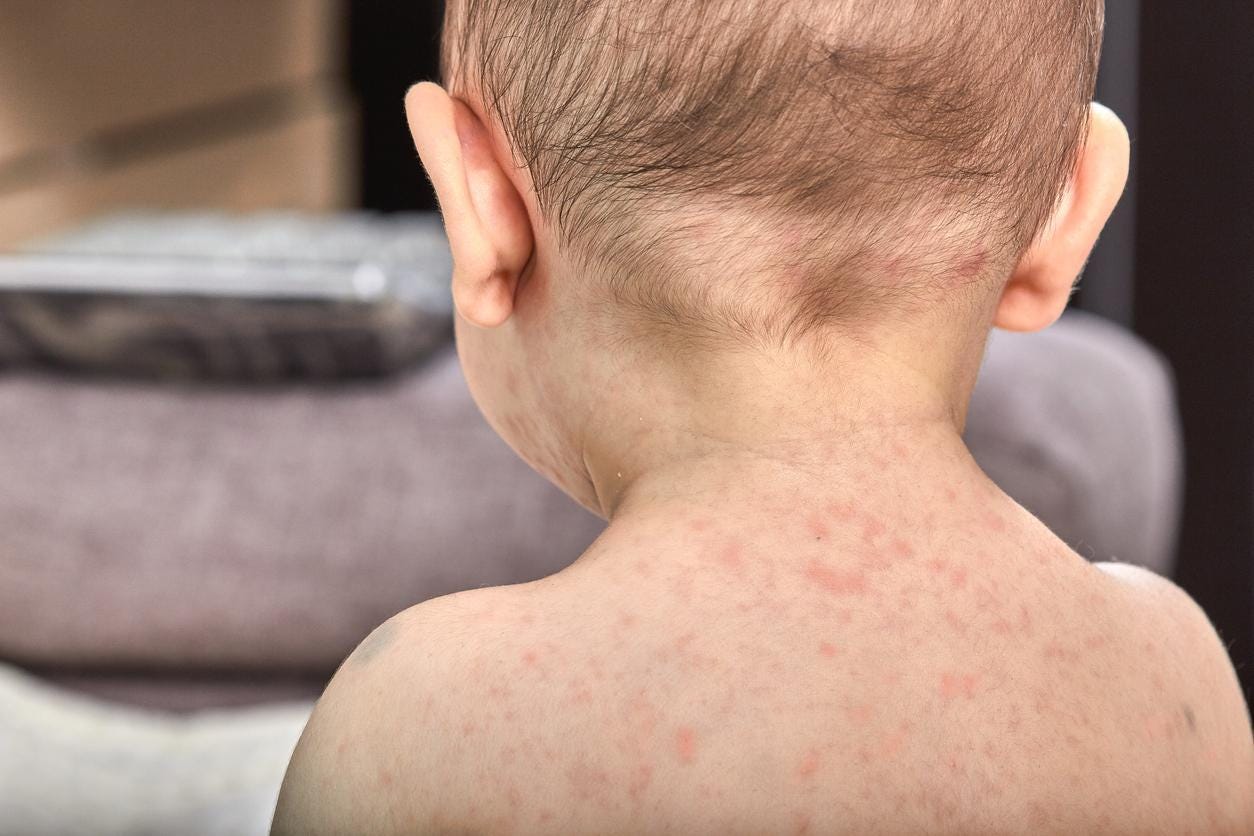
The story to date isn’t great. In 2025, America had its worst year for measles since 2000, when the virus was declared eliminated. And yet, last year alone, as Reuters reports, the disease sickened more than 2,200 people across 45 states. More than 150 children were hospitalized. Two unvaccinated kids and one adult died of complications, the first measles deaths in the United States in a decade.
The first chapter in the measles-failure story opened in January 2025 in Gaines County, Texas, when a Mennonite community reported a cluster of cases. As the New York Times reported, the count climbed from a handful to dozens to “more than a hundred,” and then kept moving for a year.
By July 2025, the Centers for Disease Control’s data crossed a symbolic threshold: more confirmed measles cases than any year since elimination. Starting in August 2025, Utah and Arizona crossed the 100-case mark in a border-region outbreak in communities where vaccination rates had reportedly dropped to around 78 percent—far below the roughly 95 percent coverage needed to shut down measles. In that reporting, Jessica Payne, an epidemiologist who leads the immunization program at the Utah Department of Health and Human Services, said the quiet part out loud: public health had been “holding our breath” waiting for this to happen. And then it did.
Next chapter. By November 2025, as the NYT followed the story, federal and state officials were on a conference call about an “uninterrupted” chain of transmission, tracking a subtype identified in the reporting as “9171,” first seen in Gaines County. Dr. David Sugerman, leading the CDC’s measles response, warned that the country’s elimination status remained “very much still under threat” if the same sequence continued to transmit through the end of January 2026. Michael Osterholm—director of the Center for Infectious Disease Research and Policy at the University of Minnesota—summed up the posture in plain Midwestern triage: “I wouldn’t call the code yet, but I think the patient’s not looking real good.”
In January 2026, the chapters of failure continued. The New York Times, drawing on CDC-confirmed cases through January 13, listed 803 cases in Texas, 201 in Utah, 214 in Arizona, and 444 in South Carolina. And these are just the biggest circles in a national scatter of outbreaks and isolated cases.
Florida’s addition to the chronicle came when measles arrived at Ave Maria University. That outbreak landed in a state already sporting porous vaccine rules, bolstered by a national movement devoted to recasting willful vulnerability to viruses as “freedom.” A campus is dense, social, and mobile. It’s also a policy test. If exemptions are easy and enforcement is weak, a virus only needs a couple of mixers and a spreader or two. Voila.
Meanwhile, South Carolina’s outbreak, beginning in October 2025 and rapidly growing, carried its own grim signature: officials said they didn’t know the origin. Precisely what a fragmented response looks like in practice. Contact tracing becomes a social negotiation. Genetics and travel histories turn into optional disclosures. An outbreak takes advantage of these things.
The federal posture is also rooted in magic-user bullshit. While some within the CDC have done their job to some extent: conference calls, sequencing, surveillance, and careful language about chains of transmission, the Department of Health and Human Services, through spokesperson Andrew Nixon, issued a statement that sounded like a voice on a public-address system trying to calm a ship while the hull guzzles seawater. To date, the CDC and health agencies “continue to work together,” and the response is “effective.” Total fantasy speak. The MAGA-fascinated masses might buy it. Science-positive people should not.
Perhaps one high-profile federal voice has cut through, however. Strangely, that’s Dr. Mehmet Oz—one of the nation’s confirmed quacks—in his role as administrator of the Centers for Medicare and Medicaid Services. Oz made a forceful call for measles vaccination in February 2026. A useful move. Apparently, even quacks get scared of real, science-backed data (from time to time). But it’s all a bit too late. Months, if not years, into the quasi-suicidal anti-vax movement’s surge across American consciousness, the nation needs more than a single televised statement from Oprah Winfrey’s poorly chosen friend. The nation now requires a substantive messaging campaign that makes vaccination boring again—normal, expected, socially enforced.
The silence of the federal government, otherwise, is just as much the point. In the Utah and Arizona story, public health officials spoke as if they were simply watching an old dam crack: they had waited for the moment when low coverage would enable the spread. Nothing anyone could do about it. Indeed, the political class—especially the national political class—is largely treating the implications of the measles outbreaks as background noise. New epicenters in Florida, Utah, and South Carolina drift across the news feed like storms that are happening somewhere else, somewhere far away. Until they don’t. And that’s the American way.
If all of this seems to echo the rise of the world’s most recent and unnecessary pandemic, it’s because the mechanics of denial remain the same. COVID-19 should have taught the American public a brutal lesson about blind spots. That is, in the U.S., when warnings arrive early, and the body count is still hypothetical, a significant part of the public simply treats those alarms as unimportant. Or, some Americans say, it’s all a conspiracy to chip humans or somehow plant a kill-switch in their bodies. Or, elements of America treat the ensuing disaster as fate. God-sent. Whatever. And then, as soon as a crisis is over, sizable parts of the public treat the aftermath as instant ancient history. Back to those cubicles, everybody. Shareholders demand value.
The same cycle is now visible with measles, except measles is an older, simpler, and more humiliating threat. Because measles has a longstanding and safe vaccine. Because measles has a long-established and effective playbook. The United States spent nearly 40 years, in fact, building the conditions for its elimination, and the nation achieved it 25 years ago. Now, for extremely dumb reasons, America cannot—or will not—keep vaccination high enough to break transmission chains. Measles is back, baby. Try the raw milk.
Of course, none of this is strictly localized. Disease and transmission denialism have gone international, just like fascism, White supremacy, theocratic insanity, and lawless killing. In November 2025, for instance, Canada lost its measles elimination status after failing to control an outbreak that began in October 2024. To regain elimination, America’s neighbor to the north must show zero endemic spread for 12 consecutive months, and experts emphasized the obvious lever to reach that goal: increased vaccination reach. No shit. The same NYT reporting warned that Mexico’s elimination status was also at risk, with case counts in the thousands and a looming one-year milestone. Across the Atlantic, England has been dealing with its own measles problems, including outbreaks in London. The reporting is consistent across the board. These instances stem from the same root cause: vaccination coverage falling short of targets in affected communities.
And, of course, it’s not just MAGA and MAHA fanatics responsible for scaring vulnerable folks off the long-established and safe benefits of a vaccine-filled needle. No, the COVID-19 pandemic reinforced a peculiar aspect of the human psyche.
Pandemic fatigue. The World Health Organization frames it as demotivation to follow recommended protective behaviors. It emerges gradually and is shaped not only by individual psychology but also by how governments communicate, support, and enforce public-health measures. Researchers such as Steven Taylor and his colleagues, publishing in the journal PLoS ONE, have tried to quantify pandemic fatigue and parse who experiences it, describing it as a chronic stress reaction that perpetuates viral spread. Bottom line: pandemic fatigue causes people to let their guard down and allow rules and processes to become porous. And viruses love porous rules and processes.
Then comes an even less attractive human glitch: risk perception decays fairly swiftly. Disaster research from Craig Trumbo and team in the journal Risk Analysis documents the pattern. After a hazard, people’s sense of danger tends to lessen, and preparedness behavior tends to decline unless institutions actively maintain attention and enforce norms. In other words, the public does not proactively prepare; it only gets busy on prevention and self-protection when the environment reframes preparedness as a life-or-death decision in the moment. Say hello to climate change, everyone. It’s hanging out with COVID-19. They both think humans are going to fuck this up. Again.
The United States, of course, already has a storied habit of turning trauma into yesterday’s trivia. Japanese internment becomes a paragraph in a textbook. “Never again” becomes an empty slogan as soon as a convicted felon gets his mafia masters into the Oval Office. Outcomes like the ongoing measles outbreaks happen when enough people decide yesterday’s emergency is today’s inconvenience.
Measles in 2026 is the public-health mirror of a very civic failure. Measles will keep spreading as long as enough people choose to go unprotected, and as long as governments treat vaccination as a consumer preference instead of a civic baseline that should be preserved to save everyone.
This time, the failure comes with a rash, a fever, and lifelong health complications—plus a death toll. Meet the new unnecessary catastrophe. Same as the old unnecessary catastrophe. Because being forced to catch someone else’s viral load in an airflow is what it takes for too many Americans to define themselves as “free.”
Well put as usual