Maps
Americans have tolerated the current era of gerrymandering since at least 2010—the nation just found out what ‘redistricting’ means under the Trump regime

On April 29, 2026, two decisions in the United States dramatically changed the playing field for the nation’s upcoming elections—both the 2026 midterms and the 2028 nationals. The Voting Rights Act has been read out of existence in Louisiana, and Floridians are now facing a chaotic redistricting as its loathsome governor declares the end of Florida’s swing-state status in his time.
First, the U.S. Supreme Court ruled 6–3 in Louisiana v. Callais that the state’s congressional map—which a federal court had ordered redrawn in 2024 to create a second majority-Black district—was itself an unconstitutional racial gerrymander under the Fourteenth Amendment. In what may be this era’s most cynical misrepresentation of reality, Justice Samuel Alito wrote for the majority that “vast social change has occurred” in the South, the New York Times reported, and that compliance with the Voting Rights Act no longer justified race-conscious districting.
Of course, this is untrue. A Brennan Center study by Kevin Morris and Michael Miller, the Times notes, found that the Black-white turnout gap in the states and counties that lost federal oversight after the Supreme Court decided Shelby County v. Holder in 2013 widened by 9 percentage points between 2012 and 2022. In that 2013 case, Chief Justice John Roberts gutted the VRA's preclearance regime (i.e., the requirement that states with histories of voter discrimination get federal approval before changing voting laws). Roberts declared preclearance outdated because, he wrote, "our country has changed." That's hundreds of thousands of uncast ballots since Roberts ended the provision. His opinion is a textbook success-as-obsolescence argument—i.e., the rule worked, therefore the rule is no longer needed. That was Roberts's reasoning then, and it's Alito's reasoning this week.
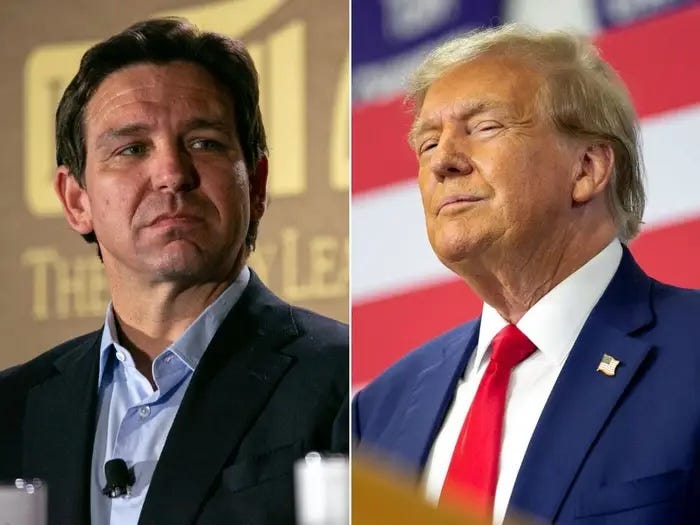
Meanwhile, down in the perversely nicknamed Sunshine State, it was also Governor Ron DeSantis’s lawyers’ reasoning on Fair Districts—the voter-passed Florida amendments banning partisan gerrymandering. Indeed, just a few hours after Alito’s steaming pile-of-shit opinion was released, the Florida legislature passed its own new congressional map, eliminating four Democratic-held seats—one in Tampa, one in Orlando, and two in Fort Lauderdale. The vote in the Florida House was 83–28; in the state Senate, 21–17, with four Republicans voting no.
This bit of satanic cartography was drawn, according to Times reporting from Tallahassee, by a single DeSantis aide, Jason Poreda, over the course of two weeks. Poreda acknowledged in committee that he used partisan data. And while Florida’s constitution bans partisan gerrymandering under those same Fair Districts amendments voters passed in 2010, DeSantis’s lawyers told lawmakers that the amendments simply no longer apply. They cited a Florida Supreme Court ruling last year. DeSantis appointed six of the seven justices on that court. Welcome to the show.
These moves are the culmination of an ongoing, long-standing gerrymandering war. The battles for the validity of the American ballot have been escalating in acute ways, especially since Republican operatives launched Operation REDMAP in 2010. This was the Republican State Leadership Committee’s targeted dark-money push into state legislative races after Citizens United, and it gave the GOP control of the redistricting pen in 10 of 15 key states going into 2011 (see David Daley’s Ratf**ked, published in 2016, for more on this move). It was also but one siege among many. The red-led assaults on free and fair elections picked up with even more energy last summer, when Donald J. Trump urged Republican-led states to redraw their maps mid-decade for partisan gain.
And yet, the Democratic response to the Republican gerrymandering project was a procedural one—creating fair-map commissions in states they could win, launching lawsuits in states with documented voter-discrimination histories. Granted, these were the only moves open to a party that had been locked out of state legislatures since 2010—meaning Republicans, after REDMAP, controlled the chambers that drew the maps in most of the most contested states. Indeed, the GOP ended up with the power, the Brennan Center found, to draw the lines for nearly four times as many districts as Democrats in the post-2010 cycle. Nonetheless, going procedural was a profound misreading of an opponent that was visibly dismantling the procedural machinery itself.
Democrats should have gerrymandered in every state they controlled and treated state-legislative races as the post-Obama national priority. They did neither.
Case in point: When, by Daley’s accounting, the Democrats won the popular vote for the U.S. House in 2012 by more than a million votes and lost the actual chamber by 33 seats, the party then spent the next decade pushing for its own independent redistricting commissions in states it could win. Those states included Colorado, Michigan, and Virginia. Democratic lawmakers may have believed that fair maps would beat unfair maps if enough states adopted them, but in committing this catastrophic blunder of reasoning, the Democrats brought a procedural-reform argument into a power struggle Republicans had been waging with both hands since 2010—and they lost.
The result is what America is now watching: The GOP dismantling anything like normal midterms this year and, almost certainly, the prospects for a fair national election in 2028.
The math is not pretty. Per the Washington Post‘s tally as of April 29, Democrats have drawn nine new districts to their advantage in three states since this current round of madness began. Republicans, however, have drawn 13 new districts to their advantage in five states. And Florida’s four new seats make it 17 to nine. Phil Weiser, Colorado’s Democratic attorney general, told the Times: “One of the lessons of the Trump era is a failure of imagination about how many norms they [Republicans] would break.” Yes: It turns out the GOP is a lot better at taking a cynical, anti-democratic strategy and running it to extremes. No shit, Phil.
Louisiana is the obvious and current case in point. After the 2020 census, the Times reports, the state's Republican legislature drew a map with but one majority-Black district. A federal court ruled the map likely violated the Voting Rights Act and ordered the state to redraw it. Louisiana complied. The Supreme Court has now ruled that the compliance map is itself unconstitutional—that following the order to remedy a Voting Rights Act violation produced a violation of the Fourteenth Amendment. Compliance is now the problem. Kafka would be proud.
In Florida, where Ron DeSantis’s evident goal in life is a daily mouthful of the president’s ketchup-splattered shoe leather, Washington Post analyst Henry Olsen notes that the outcome of the governor’s rammed-through redistricting—DeSantis’s people refused to release the draft map until the day before the sessions to debate it began—swaps four Biden-era districts for districts Trump carried by between nine and 18 points in 2024.
Additionally, Olsen reports that there are now nearly 1.5 million more registered Republicans than Democrats in Florida, a shift he attributes to demographic turnover—older Floridians dying, Democrats moving out, and new arrivals registering as Republicans. The state’s 2023 voter-list-maintenance law, Florida Bulldog reports, accelerated the trend, with nearly a million voters moved off the active rolls by the end of 2023 and another roughly 600,000 inactive voters removed from the rolls in 2024, per the figure Olsen cites. DeSantis’s move delivers a death blow to the “swing” in swing-state Florida. Meanwhile, the state’s Democratic Party chair, Nikki Fried, the New York Times reports, called the legal argument behind the new map “asinine.” The map will be challenged, of course, but those lawsuits will (again) land in a state Supreme Court whose composition DeSantis built.
None of this—the Callais opinion, the Florida map, the Democratic strategic failure—happened in a vacuum. It’s not that the United States couldn’t have known these approaches would develop. It wasn’t that the nation couldn’t have seen them unfold in real time in recent (and not-so-recent) years. Smart pundits tried to tell the country that the power of the vote was up for grabs. It’s puzzling, but few seemed to listen.
Take, for instance, Ari Berman’s Give Us the Ballot, published in 2015 by Farrar, Straus and Giroux, which traced the counterrevolution against the Voting Rights Act from the moment Lyndon Johnson signed it, naming John Roberts and Samuel Alito as architects of the dismantling decades before they sat on the Court. Or look back 10 years ago, when Daley’s Ratf**ked laid out how a group of Republican operatives—Karl Rove, Ed Gillespie, Chris Jankowski—used Citizens United money and mapping software to capture state legislatures and lock in a structural House majority. Or the nation might’ve paid heed to Richard Hasen’s Election Meltdown, published by Yale University Press in 2020, which named the four threats to the integrity of American voting that were clear and present even then: voter suppression, administrative incompetence, dirty tricks, and incendiary lies about stolen elections.
None of these books had been hidden. These weren’t obscure academic texts. The Berman and Daley titles were both reviewed in the New York Times Book Review; Hasen’s was discussed in the Times by its Supreme Court correspondent Adam Liptak, who called it “prescient.” The country had its warnings.
But evidently, much of America, if not most of it, doesn’t think along these lines. Instead, much of the nation trundled along in a kind of mid-twentieth-century dream state, a fantasy of the status quo.
This is easier to understand if Americans accept that typical white, affluent, privileged post-World War II citizens never really knew a world in which righteousness and goodness were not force-fed to them as a national heritage. And while the nation turned its back on teaching civics in public schools—the Sandra Day O’Connor Institute reports that civic instruction began declining in the 1960s and was gutted further by the No Child Left Behind Act of 2002—its parents and grandparents shuffled along, nevertheless, apparently convinced that morally and ethically upstanding, good-faith activity was the baseline for politics and power structures forever and ever. Amen.
None of this was true, however. The underlying presumption of goodness has been an endemic American flaw— and so is the blindness that comes with it. Watching events play out in 2026, it becomes clear: Even if every canary in the coal mine dies, it makes no difference to the miners’ (read: democracy’s) survival if nobody ever checks the cages. Worse, what happens if the miners check the cages and decide the dead canaries are just sleeping? Monty Python always knew what was up. The nation, throughout its twenty-first-century flirtation with fascism, evidently did not.
This has been a prevailing myopia since at least 2000, when the Republicans and the Supreme Court stole a national election over a messy voting tabulation in … wait for it … the Sunshine State. That theft had two halves: a pre-election voter purge in Florida that wrongly stripped thousands of eligible Black voters from the rolls under the cover of a botched felon-match list, as Berman documented in Give Us the Ballot, and a 5–4 Supreme Court ruling in Bush v. Gore that halted the recount with George W. Bush leading by 537 votes statewide.
If the United States wasn’t prepared to stop the presses at that juncture, what could upstanding citizens really expect it to do on a more granular level, when, say, in Shelby in 2013, Roberts wrote that the VRA was outdated? Worth noting: Within 24 hours of that ruling, Texas announced a new voter-ID law that had previously been blocked under the Voting Rights Act. America also could have seen the present writ plain in the outcomes of Brnovich v. Democratic National Committee in 2021, in which the Court gave states broad latitude to impose further voting restrictions, flouting what remained of the VRA after its 2013 decision.
Going forward—if “forward” is the right word—what happens next in Florida will happen in the courts. Voting-rights groups, the Times reports, will challenge the map under the Fair Districts amendments. The case will likely land, on appeal, in the Supreme Court that DeSantis built.
In Louisiana, Governor Jeff Landry has suspended the May 16 primary, even though overseas ballots have already been mailed and early voting is set to begin within days. This is, frankly, a model of what Trump’s administration would like to see happen nationwide, not just in primaries. As Richard Hasen, in the Washington Post, puts it: “It’s naked partisanship, but under the Supreme Court’s approach to voting now, naked partisanship is more of a defense than an indictment.”
What happens with the 2026 midterms in the United States will be six months of redistricting roulette in Tennessee, South Carolina, Georgia, and anywhere else a Republican governor cares to call a special session now that the red carpet has been unrolled. What happens with 2028, per the Times‘s own analysis, is the potential loss of around a dozen majority-minority districts across the South.
In her dissent to the Louisiana v. Callais outcome, Justice Elena Kagan, joined by Justices Sonia Sotomayor and Ketanji Brown Jackson, warned that “it is for the people’s representatives in Congress to decide when the nation need no longer worry about the dilution of minority voting strength.” Those words sound right in theory, but the reality in the United States in 2026, under the Trump regime, is that the people's representatives decide very little.
America is a nation held captive by its newest slave masters, enthralled to magical thinking and the daily distractions of accumulating and counting dollars. And it is on those altars that America has sacrificed the freedom and accessibility of its vote.